African history is rich in many ways, and African hairstyles are an obvious example of richness in diversity.

Our hair ranges from kinky-coily (tight coils) to kinky coily (z-type coils ) to corkscrew calls, and everything in-between. In short, there is no single definition of ‘Black hair’ – but why should there be? We shouldn’t attempt to lump Black hair into some sort of monolithic block any more than we should do the same for Black people.
What is interesting is the diversity and history of African hair – it is noteworthy that archaeological evidence suggests that cornrows, for example, date back to as far back as 3, 500 BC (from a Stone Age rock painting found in the Sahara).
“Just about everything about a person’s identity could be learned by looking at the hair.”
Lori Tharps, co-author of Hair Story
Black hair is Black history. In the past, traditional African hairstyles were used by different cultures to communicate meaning. You could know the clan or kingdom a person belonged to just by the hairstyle worn. Traditional African hairstyles could variously refer to one’s background, tribe, age and social status: each ethnic group, for example, had braiding styles and knotting techniques that served to indicate social status and age. Some hairstyles could only be worn at a certain age, if you had a particular marital status, or for certain celebrations: the hairstyle you might wear to a wedding would not be the same as the style you would wear for a rites of passage ceremony.
During the Transatlantic Slave Trade, not far from 12 million enslaved Africans left the continent, taking with them their customs and traditions, including methods of styling and treating their hair. Slavery was abolished in the nineteenth century, but Black people felt the pressure – in various ways – to conform with mainstream, eurocentric ideals of beauty, and would straighten their hair with damaging irons and, later, chemical relaxers, to make the process of fitting into their new societies easier. The past decade has seen a revival of traditional African hairstyles, with cornrows and other styles being worn by African and non-African celebrities, appearing in magazines and even on the catwalk.
Watch the following video that showcases the sheer diversity of African hairstyles:
Let’s take a look at a few traditional African hairstyles.
Bantu Knots
This striking traditional African hairstyle can be recreated by parting the hair into sections and twisting the hair to form a spiral knot shape on the head. Bantu Knots got their name from the Bantu dialect meaning ‘people’. The first recording of Bantu Knots is around 1898, and the style is believed to have originated from the Zulu people, one of the many Bantu ethnic groups in South Africa.
The Eight Zulu Kings: From Shaka to Goodwill Zwelithini by John Laband refers to the style, saying “married or senior [Zulu] women were crowned with complexly worked topknots of hair and wore pleated leather skirts.”
Fans of the style include Rihanna, Tracee Ellis Ross, and Blac Chyna – and even Adele.
View this post on Instagram
Ochre dreadlocks

Ochre dreadlocks are believed to have originated from the Hamar tribe in the Omo valley of Ethiopia. Hair is styled into dreadlocks by applying mixed resin and water to the hair that is already sectioned into strands. Sometimes, the hair is worn with an adornment of colorful beads. The hair is a cultural symbol of the Hamar tribe.
Himba dreadlocks
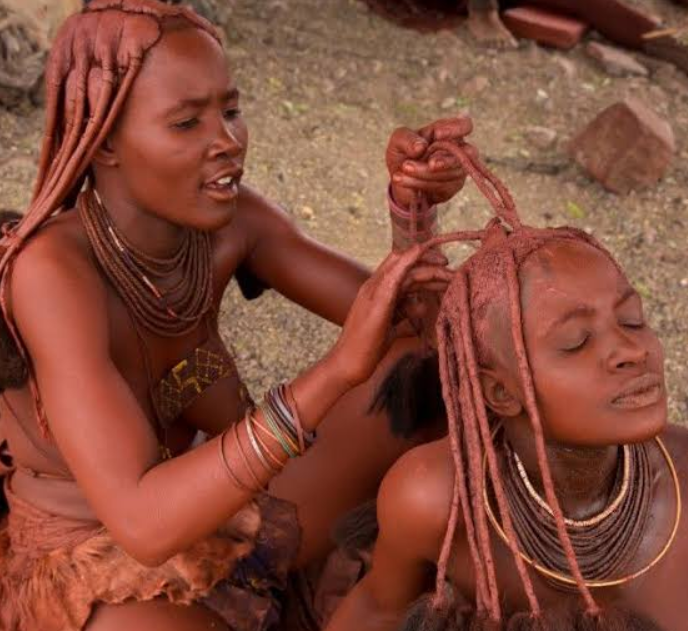
The Himba of northwestern Namibia have long been associated with the most elaborate hairstyles. Hair is dreadlocked with a mixture of ground red ochre*- red is symbolic as the colour of earth and blood – animal (usually goat) hair, and butter – a process that takes hours.
*Hematite stones are ground to get the red ochre powder. The Himba call the red ochre otjize. Aromatic resins are added to give a pleasant aroma and distinct red colour. The colour is an ever-present reminder to the Himba to remain close to their roots.
The dreadlocks convey different age groups and marital statuses both with males and females.
Very young girls can often be seeing wearing two large braids called ozondato, the exact pattern being determined by the child’s clan (or ‘oruzo’). If the young girls are one of a set of twins, they will wear a single braid. Girls going through puberty wear their dreadlocks covering their faces to avert male attention. For young women ready to marry, the dreadlocks are tied back to reveal their faces. For men, the unmarried ones wear a large single braid on the back of their head that’s called ‘ondatu‘. On marriage, the men cover their heads with turbans and only remove their turbans at funerals. After a year of marriageor following the birth of their first child, ,married women wear a headdress made from animal skin- called erembe.

The Himba have largely stuck to their traditions.
Edamburu

Ever heard that your hair is your crown? Well, the Mangbetu women of Congo took this literally as they wove their hair in intricate patterns to form the shape of a crown on their heads. The crown itself is made from thin braids woven into the shape of a crown. The braided crown is a symbol of cultural identity among the Mangbetu people, whose culture is referred to as the culture of ‘skull elongation’. The intricate design was mirrored by Beyonce (Queen Bey) in the movie ‘Black is king’ , in an homage to the richness of African culture.
Mbalantu braids: the braided ‘Rapunzels’ of Namibia

Mbalantu women of Namibia in Africa are famed for their astonishingly long, braided hair. Many Mbalantu tribe traditions revolve around hair; and as girls and women achieve various life stages, their hair is prepared in distinct styles to acknowledge their new statuses.
Amasunzu

Fulani braids
Fulani braids, also known as feed-in braids, have their origin among the Fulani people in the Sahel region and West Africa. This traditional African hairstyle has been worn for over 1000 years and is identified by the length of the hair, the centre partings and the braided cornrows that fall to the sides of the head. There is usually an assortment of decorative beads attached to the hair for an injection of creativity. Some women attach family silver coins to show socioeconomic standing in society. It is a symbol of identity among Hausa women and has worked its way into modern fashion.
Watch the tutorial:
Traditional African hairstyles are not limited to only these. However, these are some of the most striking. Whichever you would like to try, you can wear them at least slightly better informed of their history and cultural significance.
If you were to recreate one, which one of would it be?