


Climate change, financial and technological poverty, and political instability are global issues felt deeply across the globe, including in Ghana.
Move The World is a UK-based organisation pushing to keep education of Ghana’s youth at the forefront, ensuring they are not left behind in a world that demands an increasingly international and sustainable outlook.
pan-African spoke to Move The World’s founder Claire Hardy (CH) in the UK, and programme director Lawrencia Awuku (LA) in Ghana. Read on to find out more about their trailblazing work.
How did the idea for Move The World come about?
CH: We originally started in 2012 as an organisation taking dancers on cultural experiences in Africa called Awareness Through Dance, and then our chairwoman Megan Taylor and I met in 2013. But things became difficult after the Westgate mall bombing in Nairobi, Kenya that year, so we started looking for a region that checked three boxes: somewhere generally safe, easy to access from London, and that cultural roots from music to art were celebrated. At that point, Ghana was the only one that checked all these boxes. We met with renowned Ghanaian musician Bernard Woma who has now sadly passed, who founded and ran the Dagara Music and Arts Centre in Accra which has now become our home. But Megan and I realised that the dancer programmes we were running were practically ‘voluntourism’ which made us nervous, because what kind of impact does that have?
We then consulted with the chief of the town of Medie, and we asked what was needed of us. He identified two areas, which were sanitation and education – sanitation was too complex for us, but education we felt we could help with. Not by changing the curriculum or the system as such, but we could implement things in terms of engagement. By the end of 2017, we developed what is now our Get Global programmes, and in 2018 we trained ten facilitators. Our name changed to Move The World in 2016, when we felt Awareness Through Dance was no longer suitable. Ever since, we have focused on global citizenship education.
What is Move The World’s mission?
LA: Our mission is to educate the youth in Ghana on [The United Nation’s] Sustainable Development Goals (SDGs), and about how to be active global citizens in this little world that they find themselves in.
Can you share any stories of individuals whose lives have experienced positive impact through Move The World?

CH: We have two facilitators called Joseph and Kwesi, who were there when our identity was shifting, and they were also the first to be paid. We have witnessed some wonderful development throughout their six years with us.
They used to be two young men in their early 20s who would not say anything louder than a whisper, and they would help anyone without question… nowadays we can’t get them to be quiet! Joseph is now going to school which he credits to Move The World for building his confidence to say: “I want to go back to school,” and Kwesi is doing the same. They are our family, and they run the very programmes we initiated with young men like them in mind. I consider them to be my longevity-impact story.
LA: To add to Kwesi’s story, he studied visual arts in senior high school, and getting to know him over the years, he talked about being a graphic designer. When he applied to study education, I was a little surprised! It boiled down to what he does as a Move The World facilitator with the kids, together with the knowledge of the impact he knows he can make, so going into the education sector gives him real reason to study education.
It’s amazing that the lives of your staff feel a tangible impact from your work. Does this reflect in the experience of the schoolchildren you educate?
LA: When we go into schools for the first time with our Get Global programme, children sometimes question it, asking: “Why are you here?” As they progress, they become more vocal and say: “Stay! Let’s have another session!” Seeing them transform from being extremely timid, to saying that they want extra sessions really boosts your motivation and reason for doing this work. It teaches them about sustainable development, so it’s different from their regular lectures, with games and a safe space to ask questions without being shouted down in a new, all-round learning experience with real impact.
CH: Sustainable Development Goal 5 aims to achieve gender equality and empower all women and girls, which is hands-down my favourite! And after five months of getting to know the facilitator, an activity our 12-year-old students participate in is a game that would usually be mixed-gender, but this is actively split between boys and girls. Here’s the thing: the facilitators have to say that the boys won, even if they lose. Usually, the girls do indeed win, but the boys don’t second-guess their ‘victory’ at all, they often celebrate with “Yeah! We won!”
But the girls have clearly won, and there are so many daggers that it’s comical! But what happens is that girls are so comfortable with their facilitator that it opens up a conversation, challenging the result by saying: “But we won!” And it strikes up discussion about topics such as: “Can there ever be a female president in Ghana?” “Are there any female presidents in Africa?” “If boys are so much better at maths, why aren’t they working at the market?” “If I’m supposed to have children, can I still have a fulltime job?” These important and in-depth conversations happen because the students are comfortable with us.
Is Move The World facing any challenges right now?
CH: All of our funding comes from individual UK donors, and we plan to shift that by applying for grants, and to foundations. But what is currently happening in the UK government is quite scary – they have cut £4 billion of international aid, which now means that there are many more organisations applying for the same things that we are. We always hear ‘charity begins at home,’ but it doesn’t simply end there. As a small organisation there is so much more at stake, such as trust. As founder and managing director, I hug every one of my facilitators, we are friends that trust each other, and we have that because we are small. My fear is that if we cannot keep ourselves financially afloat, there will be a trust lost that goes deeper than just job-loss.
You have schools lining up to work with you – how do you manage financing your training and resources in such a difficult situation?
CH: We have so many schools knocking on our door, but helping them costs us money too. We don’t do ‘flashy’ impact work: we’re not feeding children or building schools. We work on the soft skills, so it’s a more difficult sell to funders, and our programmes are not cheap because we pay extremely fair wages to our facilitators for part-time work, their training is of a high quality, and our materials are too. We are not into the narrative of “look at this poor child, she never went to school.” It’s more a case of “this child is already in school… how do we keep her there?”
LA: From the Ghana side, it also goes back to financing. We have lots of schools knocking on our door, and the fact that we are working with a particular number of schools and other schools don’t yet have access to running our programme means they are asking why they can’t do so yet. It’s just a case of waiting for funding to come along so we can move into these schools, and we try to help maintain those relationships so they don’t lose interest as time passes.
How has the pandemic affected students in Ghana?
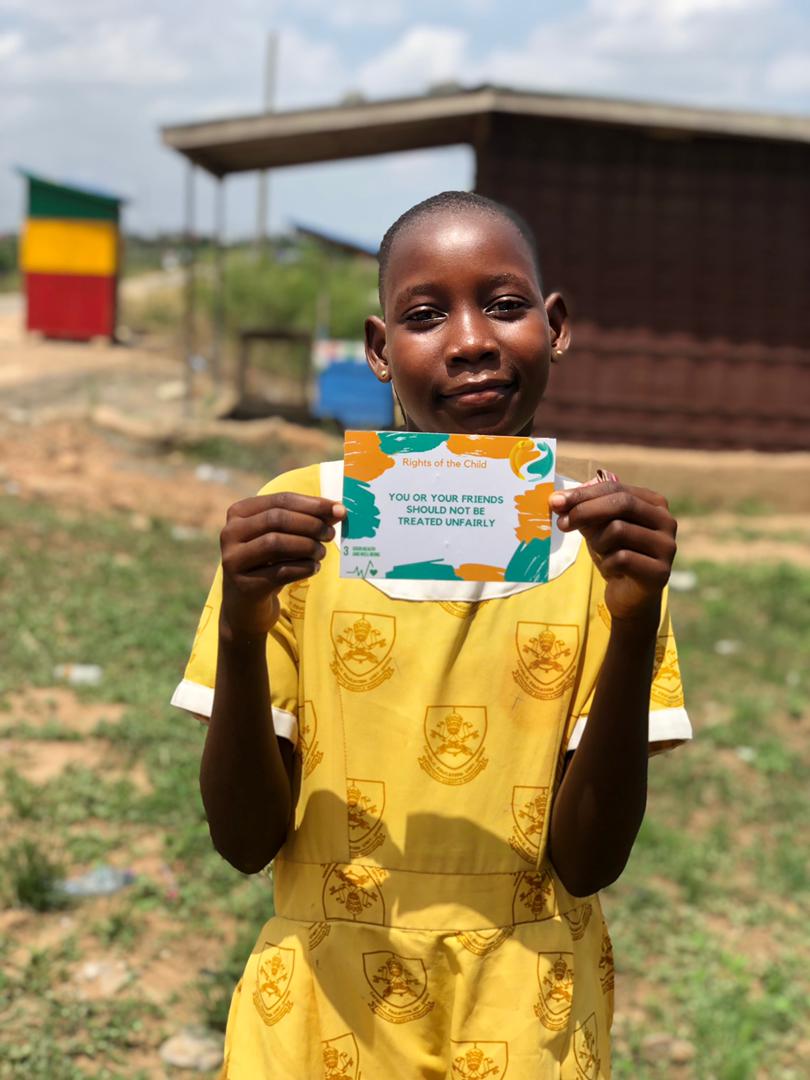
CH: Ghanaian students were out of school almost 10 months over the last year, and that puts them at a huge disadvantage compared to their global peers. They don’t have access to online schooling like many UK pupils and students, and in Medie, that was never a possibility anyway. The government initiated a ‘TV school’ programme, but not all Ghanaian students own a TV, and they couldn’t ask questions either.
The question is how do we bring these students back up to a point where they have an education, but can also think outside of the box to create sustainable and lasting jobs for a future than looks so much more different compared to anything we have ever seen?
What’s in store for Move The World for the rest of 2021?
CH: We are currently working on our Get Global 2 programme. Get Global 1 works with Sustainable Development Goals (SDG) 1 to 6 with 10 to 12-year-olds, and SDGs 7 to 12 are aimed at 14- to 15-year-olds. This is our big project this year for roll-out in January 2022.
And Ghana has changed the school system to start in January and not September anymore, so we had to change up our programmes alongside this, as well as thinking about what 2022 and 2023 might bring. Lawrencia is our only full-time member of staff, everyone else is part-time, so it’s a case of can we run 26 programmes at this kind of capacity?
Alongside the impact of your global citizenship education programmes, what kind of legacy do you hope Move The World will leave?
LA: As a small team, we are a sailboat and not a speedboat! We build and maintain relationships, we are not trying to move faster than we really can, and we just harness the wind as we go along. Not just to expand for the sake of it, but we like to take things slowly and not do it in a flash-in-the-pan way to just leave little impact. As we are small, we are also flexible and responsive in terms of regrouping to support the community we work in. That’s the Move The World legacy I believe in.
Can you describe Move The World’s biggest achievement so far?
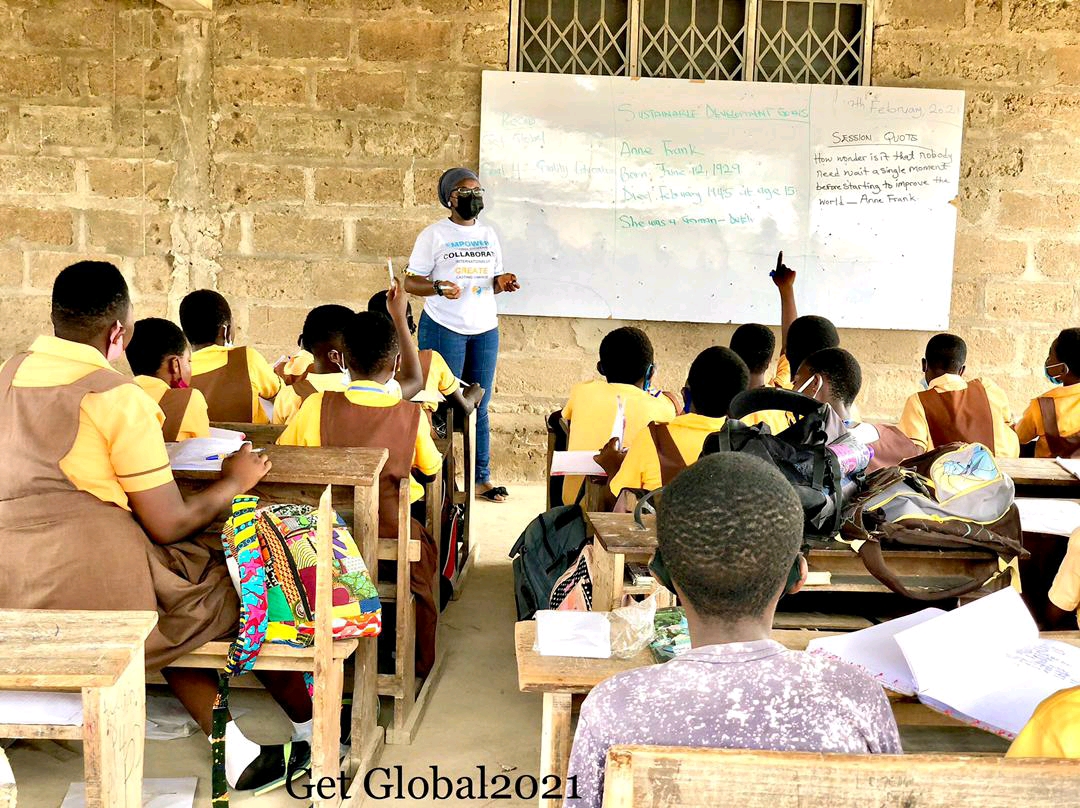
CH: The fact that we are still here! I was reflecting around Christmastime last year that from January 2019 to the end of 2020 we had run 11 programmes. This year we will have run 13 programmes and it is only June. This is a massive achievement, and we also haven’t lost any facilitator due to ill will: Move The World is a springboard to their professional progress.
What would Move The World like our readers to know about Ghana?
CH: It is an amazing place and everyone should go! The citizens are so friendly and warm – you can be the shyest person but in Ghana you will be dancing or drumming away, and not as a tourist, but as part of a family. You will instantly be at home.
LA: Ghana is a beautiful place with amazing weather. When it comes to sunlight, we are close to the equator, but we have our torrential rains too! There is culture, there is a vibrant and hospitable community, we embrace all cultures, and you’ll love being immersed in our dance, our colours, and our food!
You collaborated with two other small Ghana-based organisations for the entertaining online fundraiser Nkabom: Connecting Hearts, which culminated in each one giving a fun Dragon’s Den-style pitch!
How can our readers get involved with helping Move The World?
CH: Nkabom was fantastic, and our biggest event Lovers & Bluffers is held in February, which is a chance to get all dressed up and don your bow ties for charity. We still have a spot left for this year’s virtual London Marathon too, and you can also become a ‘Mover’ through our website where you can sign up to donate monthly, where we write to you with stories not posted online. Following us on social media is also really helpful.
Our supporters have even made apple juice from their own apple trees, and a fundraising team also climbed Kilimanjaro twice! And if you get onto our mailing list, we can send you updates.
LA: Lastly, if people want to come to Ghana and climb Mount Afadjato to raise funds for us, they are most welcome!
To discover more about and to contribute to Move The World, visit their website. You can also follow them on Instagram and Twitter.


