


In our review of Ma Rainey’s Black Bottom, we find a fine adaptation of August Wilson’s play; a film that merits all the accolades it has accumulated. Watch the trailer here:
“Ma Rainey’s Black Bottom” (2020, dir. George C. Wolfe) is based on a play by August Wilson. It’s a dramatization of a recording session of Ma Rainey’s band, which took place in 1920s Chicago, in the Jazz Age. This intimate film is shot indoors, mostly in three different rooms. Perfect for an intense, emotional drama.
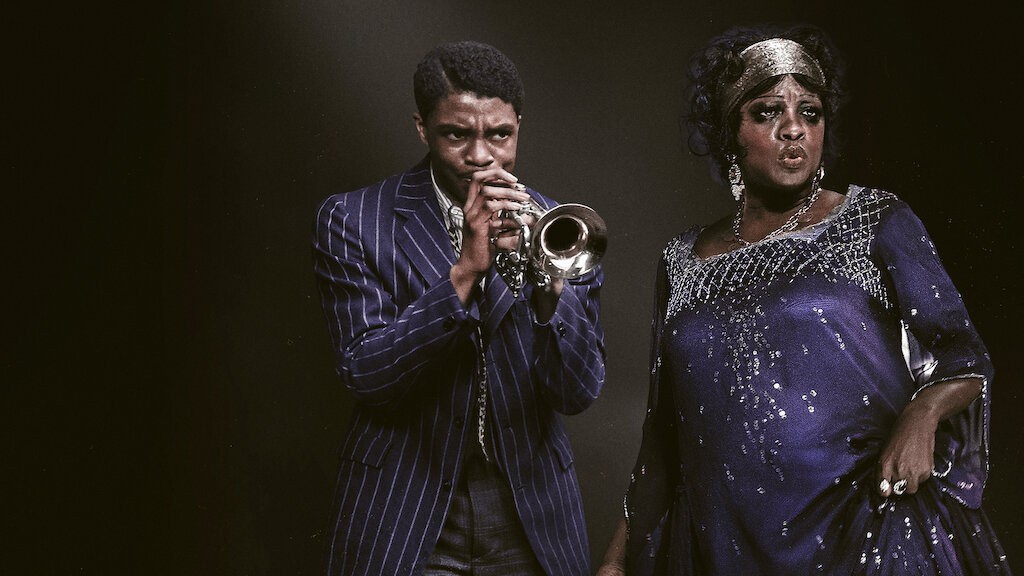
Ma Rainey was a prominent blues singer dubbed “Mother of the Blues”. She’s played by Viola Davis, who gives a remarkable performance of Rainey’s strong-willed and uncompromising persona. Her Ma Rainey is a difficult, tough character, adamant in her demands. Soon we discover the reasons for her behaviour, the insecurities she’s trying to cover up in a world of wolves, the not easily gained status she fights to hold on to.
Ma Rainey’s band, composed of black musicians, is supported by a young trumpeter Levee, played by Chadwick (Black Panther) Boseman in his last role. Both he and Viola Davis were awarded on multiple occasions for their performances, and rightly so. Boseman’s Levee is ambitious and hot-headed; he knows what he wants, but underneath his mask is simmering anger and trauma. He’s counting on his own record deal after presenting his compositions to the white bosses of the studio. He also wants to alter Ma’s songs to show his talent but Ma strongly opposes any changes to her music. It’s Ma Rainey’s “black bottom”, she says, and it cannot be any other way.
The film opens with Ma Rainey and her band on stage playing blues. Levee uses the first opportune moment to interject with an unexpected trumpet solo and steals the limelight from his boss. Ma isn’t happy with this brazen display of overconfidence. It’s a prelude to their rivalry.
Later Levee steps into the recording studio wearing a new pair of shiny shoes, shoes he can barely afford. The shoes are symbolic of the status and success he craves. It’s his big day, big chance, the moment when his life can change forever. As the story unfolds we discover his troubled past, his resentment towards white men and his arrogance towards Ma Rainey and his fellow musicians. He wants to surpass them and show his worth and his independent talent – to white men. He is wounded, cynical, stripped of all faith. We discover that when he was eight years old his mother was raped and killed by a gang of white men. His father embarked on revenge and killed a few of them before he was caught, lynched and burnt on a tree. Levee’s traumatic past – overshadowed by “the strange fruit” – is the parabola of the black people’s suffering.
Levee’s fate intersects with Ma Rainey’s. They’re also competing for the attentions of Ma Rainey’s pretty young lady friend, Dussie Mae. Ma jealously guards access to the young girl. Dussie Mae appears to be another reason for the singer to sell her songs to the studio: to maintain her lifestyle. Everybody depends on someone here. Ma Rainey is in charge of her band, a band which just wants to play, get paid and go home. Her lady friend is only there to please her. Otherwise, she gets bored, and when she’s bored she teases Levee who responds accordingly. The studio owners want their recording so they do whatever they can to satisfy Ma Rainey, who endlessly frustrates them. For example, she arrives one hour late and delays the recording further because of missing Coca-Cola bottles that were supposed to be provided. She brings her young nephew, her protégé, and insists the album opens with his announcement. But the boy stutters. It’s a moment of schadenfreude in the movie – watching him try again and again to say it right. The frustration extends from studio owners to the band. Finally, the protégé manages to say the words correctly but, due to a technical fault, the recording doesn’t happen.
This is a drama that unfolds slowly and painfully. Ma Rainey seems to be sitting with her “black bottom” on top of things, playing her game with the white men, threatening to record her songs someplace else – but it’s a façade. She reveals her biggest fear to one of her band members when she confesses that once her voice is recorded and the rights to her songs belong to the studio owners, she will be to them “just a dog in the alley”.
Racism and exploitation lie at the very bottom of this story. The recording session hints at the exploitation. And it’s not only the black people being exploited by the white men. It’s also about the artists and the greedy businessmen bent on exploiting their talent.
Levee is told that his promised deal to make his own record won’t happen. He’s paid a few dollars for his songs by the studio and is also fired by Ma from her band for his arrogance. In theory, that alone should teach the young upstart a lesson. But he cannot handle his disappointment, nor can he deal effectively with his unresolved anger. Like a typical tragic protagonist, Levee has a flaw – he’s a proud fool. There’s a touch of Greek tragedy in this film: it is Levee’s past that decides his future. He blindly assumes he has everything figured out. He boasts to his fellow band members, though they are older and more experienced. They know the sins of youth, so they warn him and consider him as a fool for pushing his luck. The old musicians, almost like a chorus in a Greek tragedy, preach the prophecy but Levee, deaf to their counsel, submits himself to his inevitable destiny. His hubris is evident when he threatens God with a knife in his hand. We wait for Levee’s knife to do more than just stab the air.
The symbolic “black bottom” is reached in the finale. Levee’s dream falls apart; he’s desperate to save what he has left out of his pride – the shiny shoes he can’t stop polishing. “There’s nothing wrong in having the good shoes” – but for Levee, the expensive pair is connected to his broken soul. When band pianist Toledo accidentally steps on them, Levee attacks him with a knife. The old man dies in Levee’s arms and the other musicians look at the scene struck by the horror and absurdity of that act. One black man killing the other black man because he fails in the white man’s world is the darkest commentary on racism there is.
This is, in the final analysis, a story about all of us. It is a story about the fragile human condition. The need to feel safe, significant. Loved. To each man has been given ambitions and dreams but some, like Levee, aim too high too soon. Perhaps that is the inevitable consequence of a broken soul: the urgent drive to fill a gaping hole; unchecked, it is ultimately to be controlled by it.
Self-interest takes centre stage in this story. No one wants to compromise but everyone has to give up something. Ma Rainey gets her money and a bit more fame reproduced on the black vinyl discs. After the session is done, Ma Rainey hurries out of the studio only to be chased by a studio manager to sign off the rights to her recorded songs. Viola Davis plays the role of Ma Rainey with such brilliance that for a moment we buy into the act that that Ma doesn’t care about her songs anymore. She signs the transfer documents as though she is shaking off a part of her soul. She finally leaves in her fancy car with her material possessions (almost) intact. The camera shifts to Levee holding the dead Toledo but Ma Rainey, too, has lost much more than she will acknowledge.
Only the studio owners get what they wanted – Ma Rainey’s blues album and Levee’s compositions. Levee could choose a different, patient approach – but without humility and forgiveness of self and others, he is unlikely to succeed.
The film ends with a white orchestra recording Levee’s compositions. It is an irony that also belongs to genre of Greek tragedy. Levee’s songs become famous, but he does not. He has sold his soul to the devil, his creations to the white bosses, and a promising young man’s dream ends up in a bloody crime, on the black bottom of a black man’s soul.


