


An example of meaningful philanthropy – Nakatindi
Philanthropy in Africa is big business – it has been for many years. The Bill and Melinda Gates Foundation alone will have invested around $5 billion (£3.75 billion) in sub-Saharan Africa by 2021. And this is just a fraction of what is invested by foreign governments. According to the Gates Foundation, childhood mortality rates globally have been halved as a result of such investment, equating to six million lives saved. The numbers are dizzying.
It can be easy to get distracted by overarching banners such as ‘family planning’, ‘agricultural development’ and ‘financial services for the poor’ and lose sight of what these top-down programmes actually mean at the grassroots level. Complementing philanthropy’s heavyweight donors are legions of smaller, independent organisations operating on a much more localised level. Many of them will select a smaller initial focal point for investment before (hopefully) seeing the rewards of their involvement spread, from the ground up, to benefit an entire community and often those around it. For such organisations, it is of fundamental importance to tailor the programme of investment to the specific needs of the population in question.
‘Where do you live? Nakatindi? That’s the bush!’
Such was the local opinion of this community of around 5000, situated along the northern edge of Zambia’s Mosi-Oa-Tunya National Park. The villagers would see countless 4x4s, full of expectant, khaki-clad tourists, passing along the adjacent highway en route to one of the luxury lodges that flanked the nearby Zambezi river. Some may have been lucky enough to secure employment at one of these lodges but in the main, Nakatindi was characterised by limited infrastructure and few formal employment opportunities.
It is not uncommon for safari camps and lodges to hire from local populations, sometimes if only to minimise transportation costs. And in the luxury travel sector, it is very much de rigeur to support and develop opportunities in neighbouring communities. It is a way of giving something back but also engendering tolerance for the wildlife that tourists come to see, but that can equally be a significant headache for local populations. A major draw for visitors but some animals, most notably elephants and baboons, wreak their fair share of havoc on nearby village’s crops and fruit trees.
In 2010, Abercrombie and Kent Philanthropy (AKP) alongside Sanctuary Retreats, who own nearby Sussi and Chuma Lodge, began a partnership with Nakatindi village. Their goal was to create a positive link between tourism and the community by establishing and developing projects that focus on health, education, conservation and enterprise. Over the years, this partnership has seen the construction of a new clinic that welcomes 50 people each day and serves a population of nearly 12,000 in Nakatindi and the surrounding communities. More recently, AKP helped fund a maternity ward offering free ultrasound scans and HIV testing for expectant mothers, with subsequent positive cases being treated to avoid the virus being passed to the unborn child. Refurbishment and extension of the school have seen attendance double, no doubt helped by a scheme that feeds all 800 pupils each day.
‘A woman is a flower in the garden and her husband the fence around it.’ – Akan proverb from Ghana
Laudable and effective as these projects are, there are other similar schemes in place elsewhere in Africa and around the world. Where AKP’s approach differs in Nakatindi, is in its enterprise projects that aim to deconstruct gender stereotypes and change long-established mindsets. One needs only to look at the many African proverbs, passed down through the generations, to understand the perceived role of women in many African societies. And while urban, cosmopolitan Africa has seen a shift in the gender balance in recent years, in more rural communities a patriarchal society remains very much the norm.
Yet delve a little deeper into African proverb and you will find examples suggesting that without women, men do not function as effectively.
‘Man head, woman neck.’ – Yoruba proverb from Nigeria
In September 2015, a shipping container arrived in Nakatindi. The container itself would become the home to a new social enterprise; its contents, around 500 donated bikes in various states of repair, would become the starting capital for Chipego bike shop. Chipego (meaning ‘gift’ in the local Lozi language) would be staffed entirely by women from disadvantaged – and often vulnerable – backgrounds, selected from the local community because of their obvious potential. Their goal was to create a self-sustaining business that, in addition to providing for their own families, would ultimately benefit the community as a whole. AKP funded the cost of the first delivery of donated bikes, as well as the initial intensive two-month training course in bike mechanics. Then it was over to the ladies.
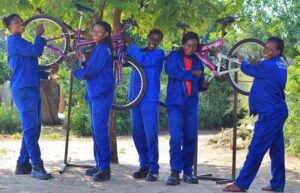
In the following five years, with 23-year-old Esther Kawewe at the wheel, they have sold over 3000 bikes, funded the resupply of several more containers of bikes and generated over $100,000 in revenue. 73% of this is recycled into the business, 22% covers staff wages and 5% is reserved for a community fund, and it is from there that the principal benefits of the scheme are realised.
Profits from the enterprise have helped to partially fund other community projects, such as the new maternity ward and have seen 20 pupils sponsored through school. The shop has also donated 30 repaired bikes to local healthcare workers and 50 to secondary school pupils, giving them the best chance of continuing their studies in nearby Livingstone. Furthermore, the salaries generated by the five mechanics help to support a total of 60 family members and dependents in the village.
‘Now, our lives are very different. Before the Chipego Bike Shop I wasn’t sure what to expect from my life. My dream was to build a house for my parents and help my brother to support our family – and thanks to this project I can say I have achieved my dreams!’ – Esther, Chipego Bike Shop
With the evident success of Chipego, as well as the ongoing support for an existing ten-strong soap making group, it became apparent that there was scope and appetite in Nakatindi for a further venture in female economic empowerment. After two years of research and planning, in 2019 AKP launched Sishemo Beads. Meaning ‘mercy’ in Lozi, Sishemo employs a team of eight local artisans who have been trained in traditional methods of glass bead making. Using discarded bottles from Sussi and Chuma lodge, the glass is fired in a locally fabricated kiln (made from bricks and termite mound clay) and shaped by hand to form attractively designed necklaces and bracelets. Their work is displayed and sold at the studio in the village as well as at partner outlets around Zambia.
Sussi and Chuma lodge’s guests can visit Nakatindi during their stay on the Zambezi and see the various schemes in action – they can even take a village tour on one of the refashioned Chipego bikes. This interaction reinforces the synergy between visitors and villagers and crucially, increases exposure of the projects which, ultimately, rely on the donations of guests, past and present.
The tangible benefits of these two projects are being felt across Nakatindi, and beyond to the surrounding communities. What is equally visible is the gradual shift in mindset, as the women of Nakatindi are provided with the opportunity to liberate their potential and broaden the scope of their historically perceived role. The philanthropic involvement in Nakatindi is less about reinventing the wheel, and perhaps more about repurposing the spokes for the road ahead.
‘When a mother is giving her child advice, let the orphan listen.’ – Lozi proverb from Zambia
Sources:
https://www.nelsonmandela.org/news/entry/gates-foundation-to-spend-5-billion-in-africa-over-next-five-years


