


In an era where the United Nations Sustainable Development Goals (SDGs) are often discussed through Western-centric lenses, Living Sustainably Here: African Perspectives on the SDGs, Volume 1 – Paths to Knowledge offers a vital, necessary corrective.
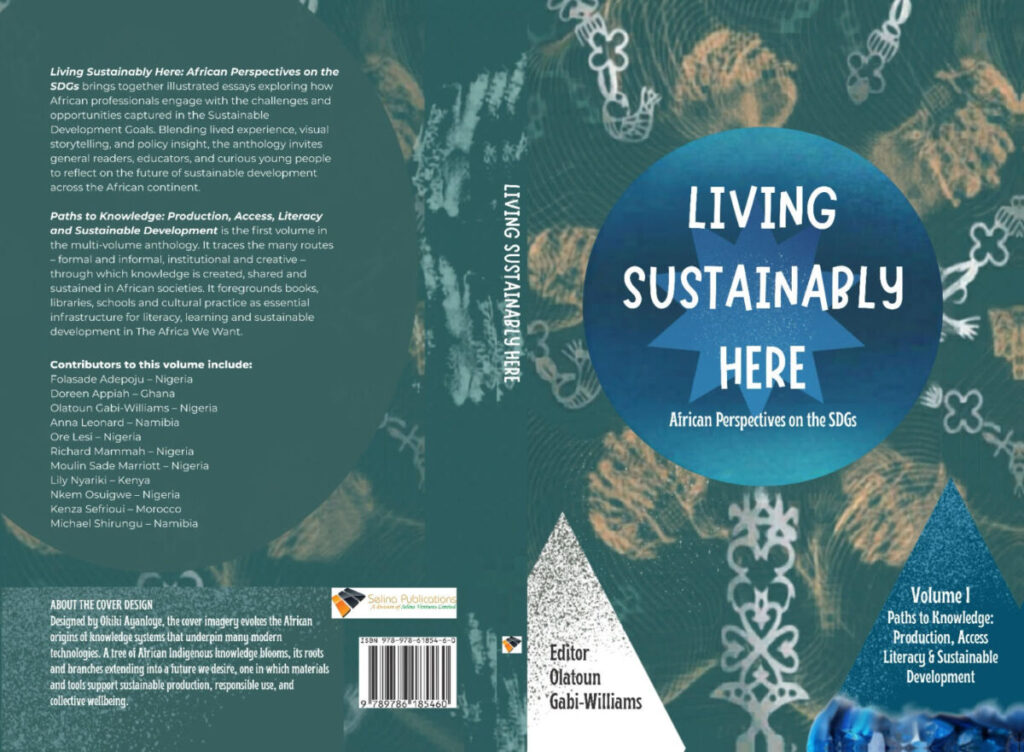
This anthology, curated as the first volume of an ongoing project serves as an intellectual and literary home for African voices, lived realities, and indigenous knowledge traditions. By centering the intersection of literature, education, and sustainable development, the book demands that we view the pursuit of sustainability not merely as a set of global policy targets, but as a deeply rooted, localized endeavor in knowledge production and dissemination.
The anthology is thoughtfully built to guide the reader through the structural and systematic issues surrounding access to knowledge on the continent. It is organized into five distinct parts that move from the macro-level of industry to the granular realities of digital transformations.
PART I: Foundations of the Knowledge Economy
Publishing, distribution, and the systems that shape access to knowledge
This foundational part examines the publishing and distribution systems that dictate who gains access to information, highlighting the essential role of African publishers and booksellers in achieving quality, inclusive education (SDGs 4)
- The New African Publishers: Towards the Promised Land by Olatoun Gabi-Williams
Gabi-Williams’s essay explores the challenges and opportunities facing African publishing, emphasizing literature’s role in cultural renewal and liberation. It argues that a growing “new literary Silk Road” is shifting publishing influence toward the Global South, creating new opportunities for African publishers. However, the essay also highlights ongoing obstacles such as limited funding and weak expertise in rights trading. The article concludes that partnerships with regions like Sharjah could help reduce dependence on western publishing systems but success will depend on equitable collaboration, historical awareness, and ensuring African publishers stand as equals in the global publishing industry.
- The Role of African Publishers and Booksellers in Realizing the United Nations Sustainable Development Goals by Lily Nyariki
Indigenous publishing is vital to preserving Africa’s identity, history, and cultural development. While early African publishers laid the foundation for the industry, inadequate government support has limited its growth. Nyariki’s article argues that sustainable education and knowledge creation depend on strong national book and reading policies, with initiatives like the UN SDG Book Club Africa needing to make more concerted efforts to connect Africa’s publishing sector to the region’s knowledge economy.
- The Role of 21st Century Booksellers in Realizing SDG 4: Quality, Inclusive and Equitable Education by Ore Lesi
This essay highlights the importance of independent bookshops in promoting literacy and lifelong learning, particularly in support of SDG 4. Despite challenges such as limited bookstores, piracy, and economic hardship, bookshops fill gaps in formal education by encouraging reading, hosting literary events, and using digital platforms to reach wider audiences. It concludes that bookstores are more than retail businesses; they are essential community spaces that foster knowledge, curiosity and sustainable national development
PART II: Institutional Custodianship
Libraries as custodians of memory and gateways to learning
This part shifts the focus to libraries as the guardians of memory and as critical gateways to learning, exploring their role in fostering a bridge to the future through public education.
- The National Library: A Custodian of Knowledge, a Partner in Education, and a Bridge to the Future by Folasade Adepoju
The National Library of Nigeria was established to be a dynamic institution that supports the country’s intellectual, cultural, and economic growth rather than just storing books. Adepoju’s essay stresses its role in making information accessible to all and the necessity of adapting to digital change. By aligning with SDG 4, the library can become a modern center of learning and empowerment, helping to turn knowledge into a public resource that supports individual development and a knowledge-based future for Nigeria and Africa.
- The Role of Libraries in Realizing SDG 4: The West African Perspective by Nkem Osuigwe
Libraries in Africa are essential, inclusive institutions that support lifelong learning beyond formal education. They serve a wide range of people, including students, workers and those outside the school system providing access to both academic and practical skills. Modern libraries are evolving into digital and skills–based hubs, offering tools like e-learning platform and vocational training. By engaging with local economic activities, they also improve community livelihoods. Overall, the article argues that libraries are crucial for achieving SDG 4 by making education accessible to everyone, regardless of background.
PART III: Education & Civic Reading Culture
Schools, reading communities, and the making of informed citizens
This part addresses the human element of the knowledge ecosystem, looking at the power of schools, reading communities, and book clubs to nurture informed, engaged citizens
- The Role of International Schools in Advancing the SDGs by Moulin Sade Marriott
International schools in Lagos could contribute to sustainable development beyond academics by supporting goals like gender equality, economic growth and environmental sustainability. However, the article argues that their current impact is limited because they focus too heavily on global curricula. To become more effective in Nigeria, these schools need to cultivate social responsibility, national awareness, and a pan-African perspective. By connecting global education with local realities, they could transform into meaningful drivers of national development
- Network of Book Clubs & Reading Culture Promoters: Revitalizing Nigeria through Reading Promotions in Diverse Ways by Richard Mammah
The Network of Book Clubs and Reading Culture Promoters in Nigeria (NBRP) is a grassroots initiative that promotes literacy and lifelong reading to build human capital. It supports SDG 4 and 8 by encouraging continued learning beyond formal education. The text argues that by promoting reading as a regular habit, the organization helps to develop an informed, skilled population which contributes to long term growth and national development.
PART IV: Contestation & Market Strain
Piracy, policy, and the pressures shaping Africa’s book economies
This part tackles the harsh realities of the African book economy, specifically addressing the damaging impacts of piracy and the complex relationship between policy and sustainable growth.
- Morocco: The International Fair for Books and Publishing: Events and Piracy vs. Sustainable Public Policy by Kenza Sefrioui
The article discusses the growth of Morocco’s International Book and Publishing Fair (SIEL), noting increased government support and rising attendance that have made it a major cultural event. However, it argues that these successes mask deeper problems in the publishing sector, including widespread book piracy and the absence of a strong national reading policy. These issues continue to threaten the long-term sustainability of Morocco’s publishing industry.
PART V: Digital Disruption & Open Knowledge
Open systems, digital access and the question of who owns knowledge
This part concludes the volume. It confronts the future, analyzing how open science, digital access, and open education resources (OER) are challenging traditional notions of ownership and accelerating progress toward sustainable development.
- The Impact of Open Science in Digital Publishing on Academic Libraries in Namibia by Anna Leonard & Michael Shirungu
This essay discusses how open science is transforming libraries in Namibia into active centers for sharing knowledge rather than just storing it. Through open access publishing, digital heritage preservation, and research collaboration, libraries contribute to SDGs 4, 9, 17. However, progress is limited. Strengthened policies are needed to strengthen the role of libraries in connecting indigenous and scientific knowledge, reducing inequality, and promoting a more inclusive research system in Africa.
- Access to Knowledge for Sustainable Development: Leveraging the UN’s OER and Open Science Recommendations by Nkem Osuigwe & Doreen Appiah
Knowledge can either drive progress or deepen inequality depending on who controls access to it. Restricted knowledge reinforces social and economic divides, while open access promotes development. Osuigwe and Appiah advocate UNESCO’s Open Educational Resources (OER) and Open Science initiatives as key solutions for removing barriers to information. These approaches aim to democratize education and strengthen research in Africa. Ultimately, the text frames open knowledge as essential to achieving the 2030 Sustainable Development Agenda, and argues that open knowledge serves as a shared resource that empowers everyone rather than just a privileged few.
We agree that the UNESCO OER and Open Science Recommendations are vital for fostering sustainable development by expanding access to quality education and research capacity. By prioritizing inclusivity and equitable knowledge flow, these strategies make learning accessible. Further, they help “leave no one behind” while placing African knowledge sovereignty at the center of development.
Finally, the infographic inserted alongside the essay’s closing lines is a wise strategy, effectively translating the complex goals of open knowledge into five actionable pillars, designed to protect local ownership and sovereignty. In effect, through their emphasis on community consent and ethical data practices, the pillars advocate a “wise openness”.
Conclusion
By bridging the gap between academic and on-the-ground expertise, Paths to Knowledge does more than just analyze the current state of African publishing and education. It acts as a manifesto for long-term growth, demanding that we recognize African intellectual traditions as cornerstones of the global sustainability agenda. This volume stands as an essential resource for educators, policymakers, and institutional leaders committed to ensuring that the path to knowledge in Africa is both equitable and empowered.
For more information about the anthology and the volumes in the series, visit Living Sustainably Here.
Reviewer: Dr. Heba Mohamed Ismail

Former Vice President, Arab Federation for Libraries & Information (AFLI) 2023 -2025
Director of INELI-MENA program & Director of 2030 Arab Librarians Program
Libraries Technical Manager, Egypt’s Society for Culture & Development


