


Nigeria’s twin capital
With only about 3% of the World’s population being twins, it is definitely an uncommon phenomenon. On the rare occasion twins are encountered, they can be the subject of intense curiosity with a whole barrage of questions like this:
“Can you read each other’s minds?”, “Are you super competitive?”, “Can you feel each other’s emotions?”, “What’s it like being a twin?”
Igbo-Ora
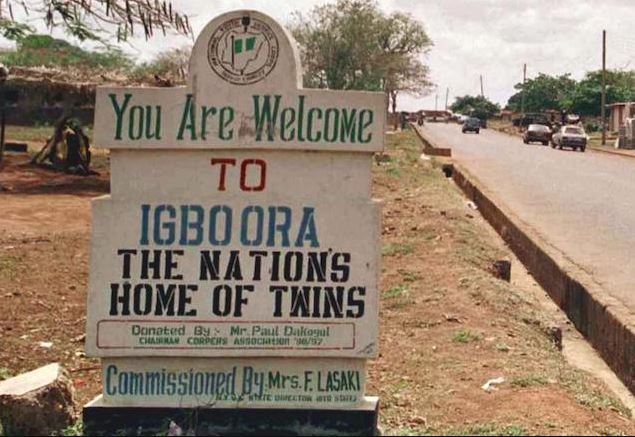
Few people get to experience the ups and downs of having a twin. However, in the sleepy, southwest Nigerian town of Igbo Ora, it is almost expected. In fact, as a visitor, you would be forgiven for thinking you had developed a severe case of double vision. Why? Because Igbo Ora is the twin capital of the world. It even has a stone plinth celebrating it. Some studies show that for every 1,000 births in Igbo Ora, 50 sets of twins are born. To put that into context, the twin birth rate in the USA sits at around 33 sets of twins per 1,000 births and in the UK, it is only about 15 sets of twins for the same number of births.
That is some serious double trouble. In fact, the Igbo Ora is so heavily populated by twins, that there are very few families there who don’t have a twin somewhere in their family circle. The first-born is named ‘Taiwo’ and the second-born, ‘Kehinde’. These names are, typically, put before the new-born’s name. The town annual also holds grand festivals and parades to celebrate their twins in all their glory.
So why is Igbo Ora the town of twins? How is it possible to have so many twin births in the one area? The local people and scientists have several theories as to how this wonder occurred.
The food?
Twin births are common amongst the Yoruba ethnic group that dominates Igbo Ora. One of the most popular theories as to why this is the case is to do with the food consumed, in particular, the okra leaf. This nutritious leaf not only is a great source of iron and vitamins, but many of the residents of Igbo Ora believe it is the secret to their incredible twin birth rate. A traditional soup, ‘ilasa’, is made using the leaf along with other spices and beans. Crucially, the soup is consumed without storing it at all, which is considered key in increasing the chances of having twins by many local people.
Chemicals found in cassava peelings and yam tubers, which are also consumed by the Yoruba people in local dishes such as ‘amala’, may also play a part in more frequent twin births, according to some research by the University of Lagos. Although, studies have not been able to prove for sure that diet is the reason for the twin birth rate in Igbo Ora, as both yam and okra leaves are also eaten elsewhere in the world, without the same result.
The genes?
Several scientists believe that the reason for the existence of this twin phenomenon in Igbo Ora, is hereditary. Due to the small size of the community and the fact that many families have remained around the local area, with ancestors intermarrying, there is a far smaller gene-pool to choose from, hence increasing the likelihood of multiple twin births. However, more research would need to be conducted to figure out if this is indeed a major factor in the twin birth rate, or if diet and other environmental factors also play a role.
A miracle?
Some of the people of Igbo Ora believe that the number of twins born to them is supernatural and that they are being blessed by God. Unfortunately, this theory is even trickier to prove. Yet, the joy and pride felt by the community when another set of twins is born, is very real and the festivals, statues and celebrations in their honour are a testament to that truth.
We may not know the real reason behind this anomaly in the heart of Africa and the number of twins in Igbo Ora is perhaps one mystery that won’t be solved any time soon. Whether it is due to diet, genetics or faith, no one knows for sure. Perhaps seeing double in Igbo Ora is a coincidence. Either way, this unusual twin town should be celebrated and appreciated for its unique and frankly, awesome trait.
Sources
Adebayo, A., Aruomaren, A., Ntoimo, L., Nwuba, R., Okonofua, F., Omonkhua, A. (2020)‘Community perceptions on causes of high dizygotic twinning rate in Igbo-Ora, South-west Nigeria: A qualitative study’, Plos One, available at: https://journals.plos.org/plosone/article?id=10.1371/journal.pone.0243169
Akwagyiram, A., Reuters (2020) ‘Nigeria’s twin town ponders cause of multiple births’, available at: https://cn.reuters.com/article/instant-article/idUSKCN1RL1A9
BBC News Africa (2018) ‘Nigeria’s twin town: Igbo Ora has an unusually high birth rate of twins’, available at: https://www.bbc.co.uk/news/av/world-africa-45979768
eNCA YouTube (2019) ‘Nigeria’s town of twins’, available at: https://www.youtube.com/watch?v=J-rlsxEi2O0
Multiple Births Foundation, ‘Media Enquiries/Multiple Birth Statistics’, available at: http://www.multiplebirths.org.uk/media.asp
Onyeakagbu, A., Pulse (2020) ‘Igbo Ora: Why does the twin capital of the world have so many twins?’, available at https://www.pulse.ng/lifestyle/fooavel/igbo-ora-why-does-the-twin-capital-of-the-world-have-so-many-twins/sl3n1sp
Speciality Produce, ‘Okra Leaves’, available at https://specialtyproduce.com/produce/Okra_Leaves_8953.php
Statista (2019) ‘U.S. twin birth rate 1980-2018’, available at https://www.statista.com/statistics/276017/us-twin-birth-rate/


