


“Books work from the inside out. They are a private conversation happening somewhere in the soul.”
Nan Shepherd, The Living Mountain
Cult of Progress, by David Olusoga
British-Nigerian historian David Olusoga is a phenomenal narrator, and his passion for his subject is palpable. His latest offering is The Cult of Progress, which is a companion to the BBC documentary series Civilisations, presented by three of Britain’s most distinguished historians: Mary Beard, Simon Schama and David Olusoga.
The beautifully illustrated book, which seeks to explore Oscar Wilde’s assertion that “ Life imitates art more than art imitates life”, brings together Olusoga’s twin passions: art and history. As such, the book analyses the role played by art in significant moments of contact, interaction and conflict that have defined the past half-millennium.
The book is divided into two parts, with the first part, titled First Contact, covering the period from around the mid-fifteenth century and the early parts of the eighteenth century and the second part, which he calls The Cult of Progress, covering the period from the mid-eighteenth century until and including the first World War.
Olusoga explores distinctive periods such as the time of the great Age of Discovery when civilisations confronted each other for the first time. This was a time of mutual curiosity, trade and the free-flowing of ideas, although it was also a time of great horrors. From an art perspective, he explores how, for example, art recorded the impact of the new developments brought by the Age of Discovery and how the period fired up the imaginations of people of that time. For example, Olusoga notes that within the art of the fifteenth to seventeenth centuries, there is a visual record of the enthusiasm and dynamism of what might be called the first age of globalization.
If you’re interested in history or art as it applies to history, you’ll love this book. Buy it.
Don’t Touch my Hair, by Emma Dabiri
“From my earliest memories, my hair was presented as a problem that needed to be managed.”
Emma Dabiri
We know that our hair is political. So how do we respond to the politics of hair? Irish-Nigerian Emma Dabiri has some answers, recorded in her excellent book Don’t Touch my Hair. It’s a serious, deep-dive into the business of hair, and she helps the reader understand the perception of African hair by showing us how it relates to tradition, culture, gender, social codes and much more besides. Dabiri is a strong writer, and she engages the reader with relatable chapter titles such as ‘Shhh… Just Relax’; ‘How Can He Love Himself and Hate Your Hair’; and ‘Everyone Wants to Sing My Blues, Nobody Wants to Live My Blues’.
The overriding message of the book is that Black hair matters. Although we can look at black hairstyling culture as an allegory for black oppression, it is also where we can express a new type of freedom. Get the book on Amazon.
The African Lookbook: A Visual History of 100 Years of African Women, by Catherine McKinley
A coffee-table book that you will read, and one for the ages, The African Lookbook is one you’ll go back to time and again. Catherine McKinley has put together a magnificent collection of historical and modern photographs of African women that span a period of a hundred years – from 1870 to 1970. It’s a fascinating, important visual history of African women told in scintillating historical photographs and stories.
I know of no other book like it. The book is a fantastic tribute to African women. What you have here is an authentic portrayal of African women that beautifully captures their styles, their emotions and their sense of self. Please buy it.
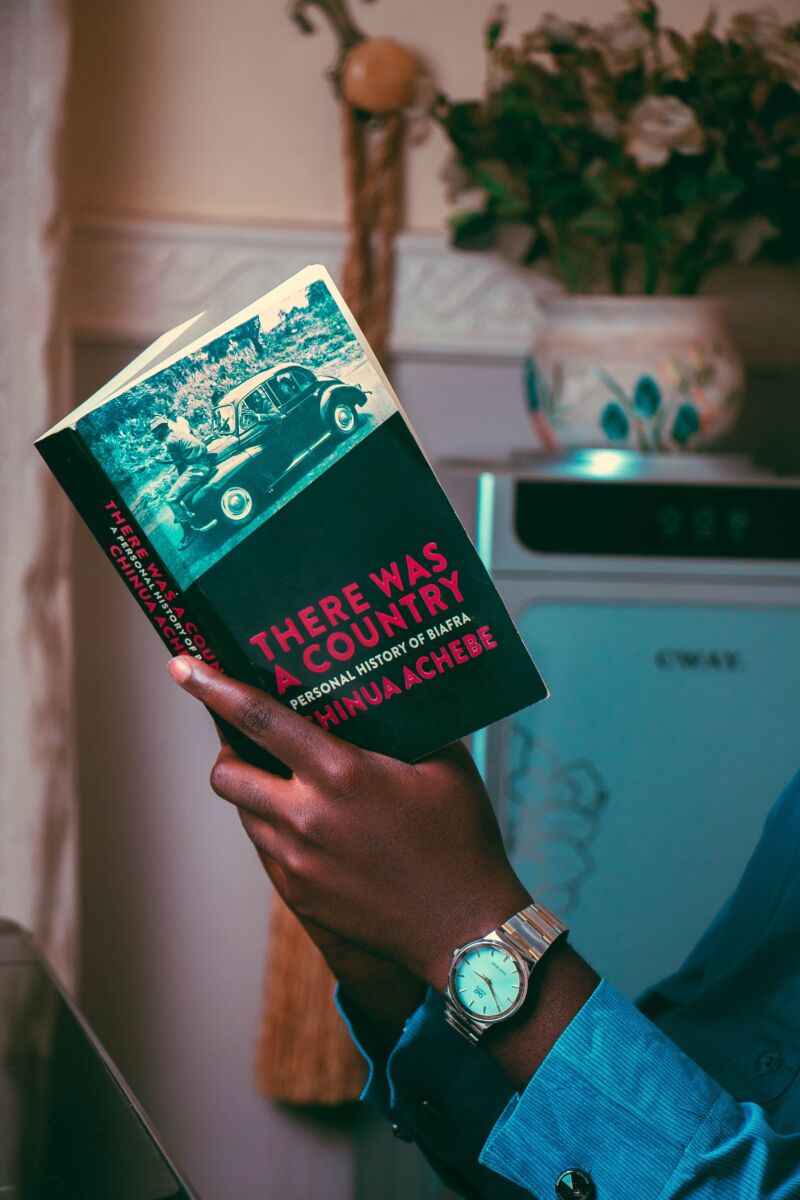
There Was a Country, by Chinua Achebe
An oldie but goodie, this 2013 book by one of Nigeria’s greatest writers is essential reading for anyone with an interest in Nigeria’s most defining war –the Biafran War. There Was a Country merges history, magnificent poetry and Achebe’s first-hand recollection of this extremely brutal period in Nigeria’s history.
The book is in many ways autobiographical but he manages to still cover the context of the conflict and the conflict itself credibly and even-handedly – the personal elements provide a good balance to the historical analysis. Nonetheless, it is a superbly written book that deserves to be read by every Nigerian insofar as it gives a robust account about Biafra, how and why it happened and Achebe’s prognosis for the future. Get it on Amazon.
The Shadow King, by Maaza Mengiste
“A brilliant novel, lyrically lifting history towards myth. It’s also compulsively readable. I devoured it in two days.”
Salman Rushdie
This is the second novel (a historical fiction) by Addis Ababa-born Maaza Mengiste, a Fulbright scholar. In this book, she revisits the invasion of Ethiopia by fascist Italy under Mussolini in 1935 – the first real conflict of World War II and the Ethiopians’ fightback for sovereignty. Two features make this book so absorbing: her florid, poetic writing and her use of photography, which allows authentic characters and scenes to be visually portrayed.
Some people have described this novel as a feminist work. It’s easy to see why: two of the central motifs relate to feminist topics – namely, it is a tribute to women: to the unsung Ethiopian female soldiers who fought alongside the men; second, it is also a commentary on the injury caused by men to their women. But the book tackles more than feminism, insofar as it is also a commentary on feudalism, fundamentalist religion, moral relativism, ethnic subjugation and horrifying abuse, in and of itself.
“Shouldn’t we be doing something too? Or is this only your country?” From The Shadow King (Aster, to her husband Kidane)
Still, Mengiste depicts her heroines in their full complexities, sharing with the reader their capabilities, beliefs and limitations as they fight to keep their world together. These women, frustratingly, appear to have been airbrushed out of African history, and the question that remains with the reader is this: why?
The Shadow King is a book that Mengiste worked on for ten years and to aid her meticulous research – she even relocated to Italy to learn Italian, a move that helped her to access Italian fascist regime archives.
With the current bloody conflicts in Ethiopia’s Tigray region, the war she writes about gives the reader an unexpected perspective with which to view today’s conflicts. Importantly, she fills a gap in the general knowledge of most non-Ethiopians about a war that is largely overlooked and a country that is not well known. Helpfully, there are talks that Kasi Lemmons will write and direct an adaptation of the novel.
“This history is not just theirs. It’s mine too. These people are part of me, and it’s African history. Who has a right to push an African away from African history?”
Maaza Mengiste
Via New York Times
Ultimately it is a book that shows us the evil that humans are capable of – but also reminds us that there is much that is good, brave and noble in us, too.
The Shadow King was shortlisted for the 2020 Booker prize – you can buy it here.
BONUS 1
Of This Our Country – a collection of personal essays from acclaimed and award-winning Nigerian writers, focusing on “the home, identity and the culture they know”. The book will be out on September 30 (2021).
BONUS 2
Who’s Who in the Yorùbá Pantheon?
The titular book is written by a magnificent three: Peju Akande, Toni Kan, and Jahman Anikulapo. Who’s Who in the Yoruba Pantheon is full of facts and fun about Yoruba tradition, and in particular, you’ll find plenty of information about Yoruba religion and spirituality. For example, readers will learn about the mysterious Yemoja, Osun and the truth about Èsù.
This is a great book for children – yes, adults too – who are in the diaspora and for whom these names may not be recognisable. In each chapter you’ll find information about the origin, the characteristics, the symbols and the devotees of each individual òrìṣa, described in a way that is entertaining and educational. This book is realised by Iwalewabooks, a publishing house, and also by the Goethe-Institut, Lagos.
If you are in Lagos you’ll find it at Quintessence, Jazzhole, Terraculture, Ouida Books and Bloom Art.


