Thinking of Mauritius likely conjures up paradisiacal white sandy beaches stretching as far as the eye can see, a dreamscape for those seeking to hit pause on the reality remote. But behind the private tiki huts and five-star villas lies a tumultuous history set against three centuries’ worth of colonisation and an enslaved people that have left gaping wounds in this tiny island nation’s identity. Wounds that even Mauritius’s 1968-won independence failed to heal. So what exactly is a ‘Mauritian’ – are they Africans or Asians? And to what extent does creole help Mauritians develop their own sense of self-worth and belonging?
A paradise island with a dark past
Mark Twain once mused that ‘Heaven was copied after Mauritius’. While those seeking out their next sun-soaked luxury vacation destination will probably only appreciate the island for its stunning volcanic scenery, the real story is much less straightforward. One reason Mauritius gives off that untouched aura might have something to do with the fact that it’s never had an indigenous population – despite being Africa’s most densely populated country today.
Measuring a minuscule 28 by 40 miles, this tiny island some 500 miles east of Madagascar lies at the point where two vast continents intersect: Africa and Asia. But it was never really a country to begin with. Rather, it was home only to the dodo and subsequently shaped by 300 years of colonisation. And its people(s)? Forcibly imported from places like China, India and Madagascar to work as slaves. Today, Mauritius is a veritable melting pot that has done very well for itself, pupating from an agriculture-based society into the economic butterfly of the Indian Ocean.
It is Africa’s only majority Hindu country, yet it is the descendants of African slaves that make up the island’s largest minority (at 30%). Slaves were initially brought over by the Dutch, from African countries like Senegal, Tanzania and Mozambique. Effectively stranded there, they were forced to bend to the whims of no fewer than three colonisers – with the French and British putting in subsequent appearances as the island’s rulers.
But what ultimately forged a shared identity among its ethnically diverse inhabitants (or Creoles, as they are more commonly known) for evermore was their dialect: Kreole Morisien.
A language rooted in colonialism
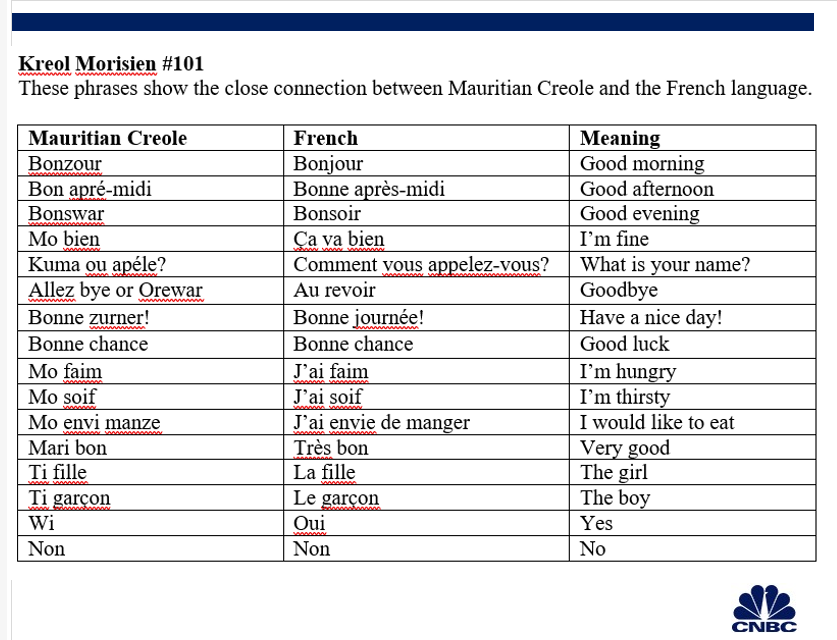
So, what is Mauritian Creole? Essentially a French-based vernacular, it was invented by African slaves who were never schooled in French, thus effectively creating their own version of the language. A version that blended French and English with mainland African and Southeast Asian words. Today it is spoken by the majority of the island’s largely trilingual population (the other two dominant tongues being French and English). Interestingly, the go-to creole dialect of this polyglot nation was not officially recognised by the state of Mauritius until as late as 2012.
In fact, by the time East Indian labourers were brought over in the mid-1800s, the dialect appears to have fully come into its own, so the contributions of the new arrivals were few and far between. Nevertheless, Mauritian creole is now the island’s lingua franca and a key part of the population’s identity and heritage.
Still, there is no denying that Europe and India underpin other areas of the country’s cultural heritage – which has made it difficult to form a distinctly African identity. Louis Amédée Darga, Chairman of the Mauritius Africa Business Club, believes that while Mauritius is geographically rooted in Africa, the majority of the zilwa (islanders) do not identify as African. The country is simply too ethnically diverse.
This view is reinforced by Ocorian Capital CEO Richard Arlove, who claims that Mauritius is doing battle with a Brexit-esque problem. In other words, it cannot really decide whether or not it truly wants to be a part of Africa.
It would be fair to say that Mauritius is caught in a sort of cultural limbo: it is neither fully African, Asian nor European, but rather a mixture of all of the above. It has formed a language that does not subscribe to any one particular culture, but rather effortlessly brings together the ‘best bits’ of those that have influenced it. It is unique – and would the islanders really have it any other way?
A proudly creole culture
Ultimately, Mauritian creole unites the island’s various communities, and links its inhabitants to their (primarily) African ancestors. At school, children are even encouraged to learn their ancestral languages – including Hindi, Telegu and Urdu. However, African heritage classes are totally missing from the syllabus. While these language sessions don’t pay tribute to a distinctly African diasporic identity, they do reinforce the island’s inherent sense of multiculturalism.
So, too, do the bountiful cultural offerings that Mauritius serves up, which play their own distinct role in creating the island’s shared (if admittedly un-African) identity. And perhaps it is a shared experience, rather than a shared heritage, that create an identity to inspire such pride. If we consider the island’s rich cultural scene, we find that it covers everything from literature to music, dance and cuisine. For example, one of the most popular traditional local dances is the sega, which originated in Africa. While the music that accompanies it is sung in Creole, the instruments (the ravanne, marvanne and triangle) used are – at least for now – of the goatskin percussion persuasion and the songs usually focus on slavery or other social injustices. All of which is traditionally African.
There is also a lively literary scene, with Franco-Mauritanian Jean-Marie Gustave Le Clézio receiving the 2008 Nobel Prize for Literature. He lived in Mauritius for a spell, and the influence on his work is evident. He writes of exile, cultural dislocation and the fraught coexistence of modernity and traditional values – but also about how self-discovery is possible against this backdrop.
When all is said and done, does Mauritius really need to ‘fit in’ with one particular continent? And given its rapid economic development, perhaps this community of displaced people should be celebrating their own uniqueness. After all, they are not alone in their plight. For instance, what does it mean to be Northern Irish, Turkish Cypriot or even from East Germany? Perhaps the focus in Mauritius should be on carving out an even brighter future as the Indian Ocean’s smallest economic powerhouse.
What do you think: is a shared identity – even an imposed, amalgamated one – enough to create a cultural legacy? Or is there joy to be found in the simple fact that your nation is happily at the crossroads of so many continents and their rich cultures?
[Sources:]
https://www.britannica.com/topic/Mauritian-Creole
https://africanarguments.org/2019/05/07/nu-tou-creole-mauritius-african/
https://www.thedailyvox.co.za/coloured-culture-real-or-imagined/
https://africa.com/heres-what-you-need-to-know-about-mauritius/
https://www.cnbc.com/2019/12/09/mauritius–french-on-this-beautiful-african-island.html
https://face2faceafrica.com/article/why-you-should-visit-mauritius-as-your-vacation-destination
https://issafrica.org/iss-today/does-mauritius-have-an-identity-crisis